Event planner workspace with laptop showing budget spreadsheet, documents, notebook, and coffee cup on a desk with a blurred conference hall in the background
Here's what nobody tells you about event budgets: nine out of ten will cost you more than planned. Industry data shows the average overspend hits 27%. I've watched planners discover this the hard way—three weeks before their conference, realizing they're $8,000 short.
Budget overruns don't just drain bank accounts. They kill trust with sponsors, boards, and executives who approved your initial numbers. You'll spend the next year explaining what went wrong instead of planning what's next. The events that actually work? They all have one thing in common: someone who tracked every dollar from the first deposit to the final invoice.
You might be planning a product launch for 200 people or a fundraising dinner for 50. Either way, you need to know where money goes before it leaves your account. I'll show you exactly how to build a budget that actually holds up when vendors start sending invoices.
Why Event Financial Planning Matters
Skip the detailed budget planning and watch what happens. You're halfway through executing your event when the caterer mentions their quoted price didn't include service staff. Suddenly you need another $1,500 you don't have. Now you're choosing: cheap out on the AV setup, cancel the photo booth, or call your boss asking for more money.
None of those options end well.
I talked to a marketing director last month who lost her job over this exact scenario. Three years running, her company's annual customer summit came in 20-30% over budget. The fourth year, her CEO just canceled it entirely. They lost a major touchpoint with their best customers because nobody trusted event spending anymore.
Here's what solid financial planning actually does: it shows you can't afford that keynote speaker everyone wants. Better to know in February than in July when you've already promoted their appearance. You can find alternatives, adjust ticket prices, or scale back elsewhere—but only if you know the real numbers early.
The Event Marketing Institute published research in 2025 showing events with detailed budgets generate 34% better ROI. That's not magic. It's spending $3,000 on a networking app that attendees actually use instead of $3,000 on tote bags that end up in closets. When you know your real constraints, you make smarter trade-offs.
Author: Ethan Marlowe;
Source: musiconmainstreet.com
Your reputation rides on this too. Attendees immediately spot the corners you cut mid-planning. I've been to conferences where lunch disappeared because they ran out of money. Everyone noticed. Everyone talked about it. That story spreads farther than any marketing campaign you paid for.
Core Categories in Your Event Budget Breakdown
Let's break down where your money actually goes. Every event budget needs these seven buckets:
Venue costs mean more than the room rental. You're paying for setup time, teardown, liability insurance, sometimes even utilities. I've seen contracts where tables cost $12 each and they needed 50. That's $600 for something you assumed came free. Read your venue agreement line by line. That "equipment" section probably charges separately for podiums, microphones, and projection screens.
Catering usually eats up (pun intended) about 25-35% of your total spend when you're feeding people. This includes meals, drinks, servers, and the 20% gratuity most contracts require. Don't forget the weird stuff: cake-cutting fees at weddings, corkage charges if you bring wine, minimum bar sales that force you to guarantee $2,000 in alcohol purchases whether people drink it or not.
Marketing and promotion covers everything that tells people your event exists—email platforms, Facebook ads, printed invitations, professional photography for promotions. If you're using an event app or online registration system, those monthly fees belong here too.
Entertainment and speakers can range from $500 for a local DJ to $50,000 for a nationally recognized keynote. You're also covering their flights, hotels, ground transportation, and meals. One planner told me she forgot to budget for the speaker's AV requirements—he needed a teleprompter, lapel mic, and confidence monitor. That added $2,800 she hadn't planned for.
Staff and labor includes everyone you pay to make the event happen: registration desk workers, security guards, janitorial services, technical crew. If your event runs past 6 PM or on weekends, expect overtime rates that run 1.5x to 2x regular hourly costs.
Technology has exploded since 2024 when hybrid became the default. You need registration software, maybe virtual event platforms, WiFi upgrades (venues usually charge $500-$2,000 for adequate bandwidth), live streaming equipment, and apps for attendee networking or lead capture.
Contingency is your insurance policy—10-20% of everything above, set aside for problems. Not "if" problems. "When" problems.
Author: Ethan Marlowe;
Source: musiconmainstreet.com
Fixed vs. Variable Event Costs
Some expenses don't budge regardless of attendance. Your venue costs $5,000 whether 50 people show up or 500. That keynote speaker still wants their $15,000 fee. Insurance, most software licenses, and baseline AV equipment all work this way—these are fixed costs.
Variable costs move with your headcount. Catering scales per person. Event swag, printed programs, and meal counts all flex based on registration. This distinction matters when you're making decisions two weeks out and registration is soft.
Say you budgeted for 300 attendees but only 240 registered. You can't reduce venue costs, but you can call the caterer and drop from 300 meals to 250. That might save $1,500-$2,000 right there.
Smart negotiating means pushing as many costs as possible into variable territory. Instead of committing to 400 boxed lunches at contract signing, negotiate for "200 minimum, up to 450 based on final count provided 72 hours prior." You're locking in per-unit pricing while maintaining flexibility on quantity.
Hidden Expenses Often Overlooked
Shipping costs blindside first-time planners constantly. That LED wall rental for $3,000? Freight both ways adds another $600-$700. Shipping twenty boxes of conference materials across the country can hit $400-$500 easily.
Gratuity and service charges stack on top of each other. Your $8,000 catering bill becomes $9,840 after the venue adds 18% gratuity and a 5% service fee. Some venues charge both separately—read that contract.
Permits matter depending on location and event type. Serving alcohol? That's a temporary liquor license running $100-$500. Food service might trigger health department inspections costing $150-$300. Playing recorded music at a corporate event? ASCAP and BMI want their licensing fees.
Payment processing quietly takes 2.5-3.5% of ticket sales. Sell $40,000 in tickets and $1,000-$1,400 vanishes to credit card fees before you spend a dollar on the actual event.
Changes cost extra. Adding 30 people three days before your event triggers rush fees from everyone: expedited catering surcharges, emergency linen orders, premium rates for additional AV gear. One planner shared that a last-minute room configuration change cost her $850 in labor fees she never saw coming.
Storage sneaks up on annual events. Keeping 35 boxes of materials for eleven months between conferences can cost $150-$300 monthly at storage facilities. That's $1,650-$3,300 a year for stuff sitting in a warehouse.
How to Build Your Event Budget Step-by-Step
Start by figuring out your financial boundaries. What's the absolute maximum you can spend? What revenue must you generate? Is breaking even acceptable or do you need profit? These numbers guide everything else.
Next, research what things actually cost in your market. Boston venue prices look nothing like Boise prices. Call vendors now for ballpark quotes—even before you've picked a date. This reconnaissance prevents you from planning a $50,000 event when you have $30,000 to spend.
Now list every single thing that might cost money. Go category by category. Force yourself to think about weird edge cases. What about name badge holders? Shipping charges? Extension cords? Get it all down.
Fill in realistic cost estimates next to each item. When in doubt, round up. Finding extra money feels great. Scrambling for money that doesn't exist feels terrible.
Rank your expenses by impact on event success. Which items directly support your core goals? A training workshop needs reliable AV and quality workbooks more than fancy linens. A donor gala flips those priorities. Put your money where it matters most.
Build in 15-20% contingency for new events, 10-15% for ones you've done before. This buffer handles surprises and gives you negotiating flexibility when vendors push upgrades.
Get three quotes for major expenses. The first venue you tour might quote $8,000 for space that the second venue offers at $6,200. Competitive catering bids can differ by 20-25% for identical menus. Five hours of quote collection saves thousands of dollars.
Document your assumptions. When you write "$2,000 signage," add a note explaining what that includes: three vinyl banners, twelve directional signs, and 200 name badges from VistaPrint. Three months later when someone questions the number, you'll remember your reasoning.
Author: Ethan Marlowe;
Source: musiconmainstreet.com
Using an Event Budget Template Effectively
Templates give you structure, but you can't just download one and call it done. A wedding budget template lists ceremony musicians and reception decorations. Your tech conference doesn't need those—but it needs bandwidth upgrades and phone charging stations.
Start with something close to your event type, then customize ruthlessly. Delete irrelevant rows. Add specific line items your event requires. A food festival needs health permits and tent rentals. A virtual summit needs streaming software and virtual event platform subscriptions.
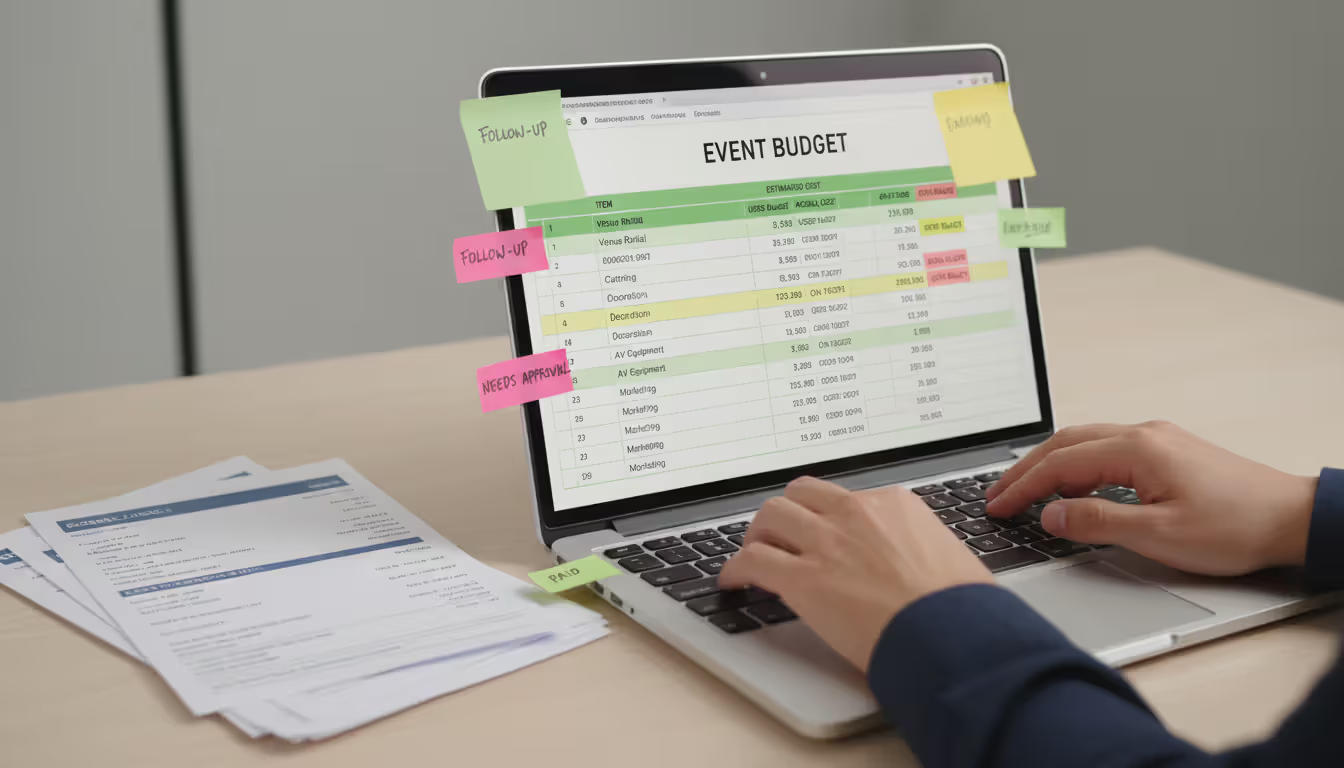
Set up columns for: estimated cost, actual cost, variance, payment due date, and notes. This turns your budget from a planning guess into a tracking system. When invoices arrive, log the real amount immediately and calculate the difference.
Link your budget to a vendor contact sheet. When you need to adjust the catering count, you want the caterer's phone number and rep's name instantly—not buried in your email from four months ago.
Update weekly during planning, daily during the final two weeks. Budget spreadsheets go stale fast. That January quote might not match the March contract you actually signed.
Color-code everything by status: green for locked in with signed contracts, yellow for verbal quotes, red for rough estimates without vendor contact yet. One glance shows exactly where uncertainty remains.
Author: Ethan Marlowe;
Source: musiconmainstreet.com
Event Expense Tracking Methods That Work
Track expenses when they happen, not when you remember to update your spreadsheet. Real-time logging means you always know what's left to spend. That awareness changes decisions: discovering you're $2,500 under budget on venue lets you upgrade entertainment quality.
Pick one person as budget owner. When three people enter expenses without coordination, you get duplicate entries, missed items, and confusion about what's actually been paid. The budget owner reviews and approves all spending before money moves.
Require physical proof for every expense. Receipts, invoices, confirmation emails—no exceptions. "I think the insurance was around $350" doesn't work. Actual documentation protects you when vendors dispute charges and provides accountability when stakeholders ask questions.
Match your budget against bank statements weekly. This cross-check catches expenses you forgot to log and spots unauthorized charges early enough to fight them.
Open a dedicated checking account or credit card just for the event if possible. Mixing event spending with regular business expenses makes tracking exponentially harder. A separate account gives you clean records and simplifies tax reporting.
Take photos of paper receipts immediately using your phone. Thermal paper receipts fade to blank within months. Coffee spills happen. Digital copies stored in Google Drive folders (organized by expense category) create permanent searchable records.
Schedule formal budget reviews at key milestones: initial planning complete, 90 days out, 30 days out, one week before event day. These checkpoints force comprehensive variance analysis and catch small overruns before they become catastrophic.
Event Budgeting Tools and Cost Estimators
Your tool choices range from sophisticated platforms to simple spreadsheets. Pick based on event complexity, team size, and what you're comfortable using.
Spreadsheet templates handle small events with one or two planners perfectly. Google Sheets and Excel offer formulas, charts, and sharing features at zero cost. Download templates built for your event type, then modify categories and calculations to match your specific needs.
Dedicated event platforms like Eventbrite, Cvent, or Whova include budgeting modules that connect directly to registration data. Your budget updates automatically as tickets sell. You can set alerts when expense categories hit 80% of allocated amounts. Expect to pay $500-$5,000 annually depending on event size and feature needs.
Project management tools such as Asana, Monday.com, or Notion adapt well to budget tracking with some setup work. Create tasks for each expense, assign dollar values, track payment status. These platforms excel at team collaboration but require manual configuration for budget-specific workflows.
Mobile expense apps like Expensify or Receipt Bank streamline receipt collection. Your team photographs receipts on-site; the app extracts dollar amounts and dates automatically using OCR. Particularly valuable when multiple people make purchases across different locations.
Essential features to look for: multiple user access with different permission levels, automatic totaling and variance calculations, export to Excel or PDF for reporting, and integration with QuickBooks or other accounting software if you manage multiple events.
Cost estimators provide ballpark figures during early planning. Many venue websites offer calculators that estimate total costs based on guest count, meal selections, and bar service level. These help reality-check your initial assumptions but shouldn't replace detailed vendor quotes.
Common Event Cost Management Mistakes to Avoid
The most successful event planners I work with treat their budget as a living document, not a set-it-and-forget-it spreadsheet.They review actual versus projected costs weekly, make adjustments in real-time, and aren't afraid to reallocate funds from underperforming categories to areas that drive better attendee engagement. That flexibility, combined with rigorous expense tracking, is what keeps events profitable and stakeholders happy
— Jennifer Martinez
The worst mistake? Wishful thinking about costs. Planners imagine vendors will discount, attendance will exceed projections, and nothing will go wrong. They budget best-case scenarios. Then reality shows up and costs 30% more.
Skipping contingency ranks close behind. "We'll just be careful with spending" falls apart when the projector dies and you need a $900 emergency rental, or when 35 unexpected guests arrive needing last-minute meals. Contingency isn't pessimism—it's professionalism.
Scope creep kills budgets slowly. Your event starts as a simple networking mixer. Then someone suggests adding a keynote. Then breakout sessions. Then a sit-down dinner. Each addition seems reasonable alone, but together they triple your costs. Set scope boundaries early and protect them fiercely.
Weak vendor negotiation leaves thousands on the table. Accepting first quotes without discussion, not asking about package deals, skipping competitive bids—all this costs 15-25% more than necessary. Vendors expect negotiation. Their initial quotes include flexibility.
Ignoring payment schedules creates cash flow nightmares. If you owe $12,000 in deposits six months before the event but won't collect ticket revenue until two months out, where's that $12,000 coming from? Understanding payment timing prevents last-minute scrambling for bridge funding.
Letting small expenses slide adds up invisibly. Four team members each spending $40 on supplies without documentation equals $160 untracked. Multiply across six months of planning and hundreds of dollars vanish without record.
Not reading contracts for hidden fees allows nasty surprises. "Coordination fee," "administrative charge," "setup cost," and "service fee" can inflate final bills 20% above quotes. Read every line. Question every charge. Get explanations in writing.
Event Budget Breakdown by Event Type
Budget allocation varies dramatically based on event goals and audience expectations. Here's how different event types typically distribute spending across major categories:
Expense Category
Corporate Conference
Wedding
Nonprofit Fundraiser
Trade Show
Venue & Space
25%
30%
20%
35%
Food & Beverage
30%
40%
35%
20%
Promotion & Marketing
15%
5%
15%
25%
Speakers & Entertainment
10%
15%
20%
5%
Technology & AV
10%
5%
5%
10%
Buffer & Other Expenses
10%
5%
5%
5%
Use these percentages as starting frameworks, not absolute rules. A virtual conference shifts venue dollars to technology. Product launches allocate more to marketing and less to catering. Adjust based on what drives success for your specific event.
FAQ
What percentage of an event budget should go to the venue?
Venue expenses typically run 20-35% of your total budget, varying significantly by event type and geographic location. Trade shows need massive floor space and often hit 35%. Corporate conferences usually land around 25%. Urban venues in high-demand markets (New York, San Francisco, Chicago) charge premium rates. The critical factor is understanding what's actually included—some venues bundle tables, chairs, and basic AV equipment, while others charge separately for everything beyond four empty walls.
How much contingency should I include in my event budget?
Allocate 10-20% for contingency depending on experience and complexity. Planning your first event of this type? Use 15-20%. Recurring annual events with solid historical data can use 10-12%. Never eliminate contingency entirely—unexpected costs surface in 95% of events. This buffer handles emergency equipment rentals, last-minute attendance fluctuations, vendor price adjustments, and the countless small surprises that emerge during execution.
What's the difference between a corporate and nonprofit event budget?
Corporate event budgets prioritize ROI metrics, brand positioning, and attendee experiences that drive business outcomes. Companies typically allocate more to technology, high-end venues, and premium catering that reflects their brand. Nonprofit event budgets focus on net revenue for the cause, requiring careful balance between creating an appealing experience and maximizing funds raised. Nonprofits often secure donated services and rely heavily on volunteers, which shifts budget allocation toward marketing and donor recognition elements.
When should I start tracking event expenses?
Begin tracking from your very first transaction—usually a venue deposit or planning software subscription purchased months before the event. Early tracking establishes disciplined habits and captures costs that become easy to forget later. Create your tracking system before signing any contracts. This discipline ensures you record every transaction and maintain accurate variance analysis throughout the entire planning cycle.
Can I reuse an event budget template for different event types?
You can reuse the structural framework but must customize categories substantially. A conference budget template needs extensive technology and speaker line items that a wedding template completely lacks. Start with something matching your event type, then modify based on your specific requirements. After completing your first event, save that customized template as your baseline for future similar events, adjusting only for inflation and lessons learned from what worked or didn't.
What are the biggest budget mistakes first-time event planners make?
First-time planners consistently underestimate catering costs by forgetting to include service charges and mandatory gratuity. They skip contingency funds entirely. They fail to track small expenses under $50. They accept initial vendor quotes without any negotiation attempt. They also severely undervalue their own time, creating budgets that only work if they contribute hundreds of unpaid hours. Another frequent error: not reading contracts carefully enough, which leads to surprise fees for services they assumed were included in base pricing. Finally, many wait too long to start tracking expenses, losing receipts and forgetting smaller purchases that collectively impact the bottom line significantly.
Building an event budget that actually holds up requires more than Excel formulas. You need realistic cost estimation, disciplined tracking habits, and willingness to make tough choices when reality diverges from your plan.
The framework I've outlined works across event types and scales: define clear expense categories, distinguish what's fixed versus variable, build adequate contingency, and track every single expense as it happens.
Success comes down to small disciplines practiced consistently. Take photos of receipts immediately. Update your budget every week. Question vendor quotes instead of accepting them. Read contracts for hidden fees. These habits prevent the slow budget creep that transforms a $40,000 event into a $54,000 shock.
Start your next event by customizing a template to match your specific needs. Fill it with realistic estimates based on actual vendor quotes, not optimistic guesses. Share it with stakeholders early so everyone agrees on constraints. Then track relentlessly, adjust as circumstances change, and document everything for your own future reference.
Your budget isn't just an accounting requirement—it's the strategic framework determining whether your event achieves its goals or becomes a cautionary tale others whisper about. Treat it with appropriate seriousness, and you'll join the minority of planners whose events consistently deliver on promises while staying financially sound.
Venue management software automates reservations, scheduling, payments, and client communications through a centralized platform. Modern systems prevent double-bookings, reduce administrative time by 10-15 hours weekly, and increase booking conversion rates by 15-25% through real-time availability and instant quotes
Event scheduling software builds, organizes, and publishes event agendas and session timetables. This guide covers how it works, essential features like multi-track support and real-time updates, common use cases by event type, and how to choose the right platform for your needs
Discover how event planning templates organize tasks, timelines, and logistics for successful events. Compare template types, tools, and formats. Learn what to include, common mistakes to avoid, and how to build custom templates that improve with each use
Event organizer insurance protects planners from liability claims, cancellations, and property damage. This guide covers coverage types, how liability works, policy selection, risk management strategies, and common mistakes to avoid when insuring events of any size
The content on this website is provided for general informational and educational purposes only. It is intended to explain concepts related to event management software, ticketing systems, hybrid event platforms, and operational tools for event organisers.
All information on this website, including articles, guides, and examples, is presented for general educational purposes. Outcomes may vary depending on event size, technology choices, and organisational needs.
This website does not provide professional legal, financial, or software advice, and the information presented should not be used as a substitute for consultation with qualified event tech or IT professionals.
The website and its authors are not responsible for any errors or omissions, or for any outcomes resulting from decisions made based on the information provided on this website.